
A lyrical analysis of Oasis’ Be Here Now, originally written in 2019
Oasis released their third album, Be Here Now, on 21 August 1997. It was met with significant widespread anticipation, and went on to become the UK’s best-selling album of 1997[1] as well as its fastest-selling album of all time[2] – internationally, it also proved a sizeable hit. It was initially given an enthusiastic critical response, with several reviews consisting of unanimous praise. Over time, however, Be Here Now’s sales and supporters dwindled and it has been retrospectively seen as excessively ambitious, too long and overproduced. In 2018, NME described it as “a rock folly, a coke-fuelled monument to ‘90s excess.”[3] It is cited as the album that prompted the decline of the wider Britpop scene, but it still produced three UK hit singles in ‘D’You Know What I Mean?’, ‘Stand By Me’ and ‘All Around the World’. The latter remains the longest track ever to reach number one on the UK Singles Chart, indicating both the scale of the music on Be Here Now and Oasis’s colossal commercial appeal.
Noel Gallagher – the group’s main songwriter – had been inspired to create songs that “escaped the strictures of orthodox rock composition”[4] and were “Bigger, Louder and Longer”[5]. In addition, the success Oasis had achieved by the time Be Here Now was written and recorded meant that they were virtually entirely unrestricted by deadlines or budgets. The decadence evident during the album’s production may have influenced its lyrics, although they largely display the same typical Oasis elements of arrogance, relentless optimism and melancholy.
Be Here Now was released following Labour’s landslide victory at the 1997 general election, and this developed a feeling of positivity that had existed for some time beforehand, fostered by events such as the aforementioned political changes as well as cultural landmarks including “Euro 96 and Britpop in general.”[6] ‘D’You Know What I Mean?’, Be Here Now’s opening track, has been described as “more rally than song”[7], and is an example of how many lyrics exist “to propose ideas about life and the world.”[8] It progresses with an authority and forcefulness that is difficult to deny, conveying this most notably in the chorus; “all my people, right here, right now/d’you know what I mean?/yeah, yeah.”[9] The first part seems to cultivate a sensation of togetherness and unity among band and audience; in addition, it reinforces the reputation of Oasis as a working-class band of the people, since Liam is singing to “my people”. The listener is thus part of the story, allowing the band’s message to gain momentum. In the rest of the song, this is used to encourage the listener to brush off life’s setbacks and approach everything with confidence. Through lines such as “get up off the floor and believe in life/no-one’s ever gonna ever ask you twice”[10], they are subjected to a degree of ethos in the lyrics, since the narrator is evidently attempting to convince the listener of their own personal strength and inspire faith in their message. It has been noted that the song’s chorus provided a particularly apparent “note of hubristic confidence”[11], linking back to the aforementioned arrogance that featured in Oasis’s earlier lyrics. Looking deeper at the words themselves, we can establish that there is use of both perfect rhymes and family rhymes. In parts of the song, they almost seem to alternate; for example, “step off the train all alone at dawn/back into the hole where I was born”[12] is swiftly followed by “the blood on the tracks, and they must be mine/the fool on the hill, and I feel fine”[13]. These lines, varying in their rhyme style, are separated by standalone ones – in this case, “the sun in the sky never raised an eye to me”[14], which helps to establish a pattern running through the rest of the song. This format, along with the repetitive nature of the chorus and the steady AABCCB rhyme scheme in the verses (the pre-chorus is ABBCC), can potentially make the song easier for a listener to memorise, thereby increasing the effectiveness of its message. The video develops this, showing Oasis performing the song in an apparently post-apocalyptic world while helicopters fly overhead and a crowd gathers. Smoke grenades are thrown, adding colour and chaos to a grey setting and bearing a resemblance to the uprising and sense of fearlessness encouraged by the lyrics.
‘Don’t Go Away’, on the other hand, is much more personal and introspective in nature. Its lyrics take the form of a plea to a loved one not to abandon the narrator. It opens with “a cold and frosty morning/there’s not a lot to say/about the things caught in my mind”[15], immediately setting a solemn scene, establishing a clear sense of pathos, and succinctly illustrating the narrator’s frustration at being unable to properly express their inner feelings. Its production was supposedly an emotional experience; Liam claims to have cried while recording his vocal, saying that “I had to go away and sort myself out”[16]. The emotional angle is reiterated notably in the lines that lead up to the chorus – “and I want to be there when you’re coming down/and I want to be there when you hit the ground.”[17] When the chorus begins, the aforementioned plea fully manifests itself; “don’t go away/say what you say/say that you’ll stay/forever and a day.”[18] As well as desperation, a sense of loss is also apparent: “me and you, what’s going on? All we seem to know is how to show/the feelings that are wrong.”[19] Such lines suggest an emotional vulnerability that is at odds with the resilience and defiance evident in other Oasis songs; on Be Here Now alone, ‘Don’t Go Away’ is preceded by ‘My Big Mouth’ (“I’ll put on my shoes while I’m walking slowly down the hall of fame”[20]) and ‘I Hope, I Think, I Know’ (“’cause baby, after all/you’ll never forget my name”[21]). In rhyming terms, the lyrics employ more examples of perfect rhymes, and more evenly so than ‘D’You Know What I Mean?’. The scheme can be established an ABABCDD, at least in the first two verses; “damn my situation and the games I have to play/with all the things caught in my mind/damn my education, I can’t find the words to say/all the things caught in my mind.”[22] At the end of these, the words “coming down”[23] are sung after a pause, separating them on their own line and disrupting the flow of the pattern, although much like ‘D’You Know What I Mean?’, the consistency of this method can again allow the song to stay in the listener’s mind.
The video matches the melancholy theme of the song, while also using more surreal elements. It depicts Liam singing in a house and caught in moments of deep reflection while the rest of the band appear around him, and an orchestra play in a desolate and blue landscape. The visuals are likely to attract attention, but they all seemingly serve to isolate Liam and what he is singing, which can in turn provoke thought and reflection among listeners.
‘All Around the World’, however, is inherently optimistic and the album’s most blatant display of grandiosity. This orchestra uses strings and horns to create a juggernaut of positivity and convince the listener that everything will be right in their world; “all around the world/you’ve got to spread the word/tell ‘em what you’ve heard/we’re going to make a better day.”[24] Such a message can be interpreted as another attempt to inspire more confidence in the listener, albeit in a manner that displays less attitude than ‘D’You Know What I Mean?’. Its lyrics are even more consistent than those of the aforementioned two songs; certain sections are repeated numerous times (“yeah, I know what I know/it’s gonna be okay”[25]), and the verses contain a series of identical perfect rhymes in an AAAA pattern, followed by AAAABB in the pre-chorus sections. In addition, “please don’t cry, never say die”[26] features an additional rhyme, with an internal one occurring on the same line.
The music video for the song emphasises its positivity – Oasis are shown performing the song in a yellow spaceship while travelling through a surreal fantasy world, apparently inspired by The Beatles’ Yellow Submarine film. The jovial tone and bright colours of the video effectively compliment the lyrics, placing Liam firmly at the centre – he and the rest of the band are dressed in white suits, thereby rejecting darker attire, and he and Noel exchange light-hearted glances, abandoning their usual seriousness and revelling in their spectacular surroundings.
The relative extravagance of Be Here Now’s music and videos extended to its promotional materials. The album’s cover featured Oasis standing around a swimming pool at Stocks House, Hertfordshire, surrounded by various props; the pool had a Rolls-Royce lowered into it, and the items included a calendar displaying the album’s release date. It is believed that this was included to equate buying a copy on release day to participating in “some kind of historical event”[27] – the album’s title may convey a similar idea. Indeed, customers who purchased it at HMV stores were given a certificate confirming they had “been there then”[28], emphasising the perceived magnitude of the occasion. On the album’s supporting tour, the stage set replicated some of the cover artwork items. A Rolls-Royce grille was used as Alan White’s drum riser, and the band entered through a red telephone box, preceded by a ringmaster who walked the stage to enliven the audience.[29] Despite such ostentatiousness, the band themselves often donned more casual attire in keeping with their working-class reputation, remaining a degree of relatability to the audience despite the nature of Be Here Now’s music and retaining the image for which they are best known to the public.
Mason
Bibliography
The Official Charts Company. ‘End of Year Album Chart Top 100 – 1997’. Accessed 6 November 2019. https://www.officialcharts.com/charts/end-of-year-artist-albums-chart/19970105/37502/
BBC Newsbeat. ‘Sorry Adele, Oasis are still the album chart record breakers’. Accessed 6 November 2019. http://www.bbc.co.uk/newsbeat/article/34919975/sorry-adele-oasis-are-still-the-album-chart-record-breakers
NME. ‘Oasis’ ‘Be Here Now’ – Was It Really That Bad?’. Accessed 6 November 2019. https://www.nme.com/blogs/nme-blogs/oasis-be-here-now-at-15-was-it-really-that-bad-770068
Harris, John. The Last Party: Britpop, Blair and the Demise of English Rock. London: Fourth Estate, 2003.
Dorian Lynskey, ‘’Flattened by the cocaine panzers’ – the toxic legacy of Oasis’s Be Here Now’, The Guardian, 6 October 2016. Accessed 6 November 2019. https://www.theguardian.com/music/2016/oct/06/flattened-by-the-cocaine-panzers-the-toxic-legacy-of-oasiss-be-here-now
Eckstein, Lars. Reading Song Lyrics. Amsterdam: Rodopi, 2010.
Oasis, ‘D’You Know What I Mean?’, from Be Here Now, Creation Records, 1997.
Oasis, ‘Don’t Go Away’, from Be Here Now, Creation Records, 1997.
MTV. ‘MTV Oasis Uncut Documentary’. YouTube. 24:35. Posted by Whenallwozkool, 4 August 2013. https://www.youtube.com/watch?v=evCXwh0vcNM
Oasis, ‘My Big Mouth’, from Be Here Now, Creation Records, 1997.
Oasis, ‘I Hope, I Think, I Know’, from Be Here Now, Creation Records, 1997.
Oasis, ‘All Around the World’, from Be Here Now, Creation Records, 1997.
Loud and Quiet. ‘Don’t just blame the cocaine for Oasis’ Be Here Now – it was kinda Richard Ashcroft’s fault’. Accessed 6 November 2019. https://www.loudandquiet.com/short/dont-just-blame-cocaine-oasis-now-kinda-richard-ashcrofts-fault/
Oasis. ‘Oasis – G Mex Arena Manchester Full Concert December 1997’. YouTube. 1:49:35. Posted by headshrinker666, 18 July 2014. https://www.youtube.com/watch?v=8N-ylUkGV2Y&t=168s
[1]‘End of Year Album Chart Top 100 – 1997’, accessed 6 November 2019. https://www.officialcharts.com/charts/end-of-year-artist-albums-chart/19970105/37502/
[2] ‘Sorry Adele, Oasis are still the album chart record breakers’, accessed 6 November 2019. http://www.bbc.co.uk/newsbeat/article/34919975/sorry-adele-oasis-are-still-the-album-chart-record-breakers
[3] ‘Oasis’ ‘Be Here Now’ – Was It Really That Bad?’, accessed 6 November 2019. https://www.nme.com/blogs/nme-blogs/oasis-be-here-now-at-15-was-it-really-that-bad-770068
[4] John Harris, The Last Party: Britpop, Blair and the Demise of English Rock (London: Fourth Estate, 2003), 334.
[5] Harris, The Last Party, 334.
[6] Dorian Lynskey, ‘’Flattened by the cocaine panzers’ – the toxic legacy of Oasis’s Be Here Now’, The Guardian, 6 October 2016. Accessed 6 November 2019. https://www.theguardian.com/music/2016/oct/06/flattened-by-the-cocaine-panzers-the-toxic-legacy-of-oasiss-be-here-now
[7] Lynskey, ‘’Flattened by the cocaine panzers’.
[8] Lars Eckstein, Reading Song Lyrics (Amsterdam: Rodopi, 2010), 10.
[9] Oasis, ‘D’You Know What I Mean?’, from Be Here Now, Creation Records, 1997.
[10] Oasis, ‘D’You Know What I Mean?’, from Be Here Now, Creation Records, 1997.
[11] Harris, The Last Party, 338.
[12] Oasis, ‘D’You Know What I Mean?’, from Be Here Now, Creation Records, 1997.
[13] Oasis, ‘D’You Know What I Mean?’, from Be Here Now, Creation Records, 1997.
[14] Oasis, ‘D’You Know What I Mean?’, from Be Here Now, Creation Records, 1997.
[15] Oasis, ‘Don’t Go Away’, from Be Here Now, Creation Records, 1997.
[16] ‘MTV Oasis Uncut Documentary’, YouTube, 24:35, posted by Whenallwozkool, 4 August 2013. https://www.youtube.com/watch?v=evCXwh0vcNM
[17] Oasis, ‘Don’t Go Away’, from Be Here Now, Creation Records, 1997.
[18] Oasis, ‘Don’t Go Away’, from Be Here Now, Creation Records, 1997.
[19] Oasis, ‘Don’t Go Away’, from Be Here Now, Creation Records, 1997.
[20] Oasis, ‘My Big Mouth’, from Be Here Now, Creation Records, 1997.
[21] Oasis, ‘I Hope, I Think, I Know’, from Be Here Now, Creation Records, 1997.
[22] Oasis, ‘Don’t Go Away’, from Be Here Now, Creation Records, 1997.
[23] Oasis, ‘Don’t Go Away’, from Be Here Now, Creation Records, 1997.
[24] Oasis, ‘All Around the World’, from Be Here Now, Creation Records, 1997.
[25] Oasis, ‘All Around the World’, from Be Here Now, Creation Records, 1997.
[26] Oasis, ‘All Around the World’, from Be Here Now, Creation Records, 1997.
[27] Harris, The Last Party, 341.
[28] ‘Don’t just blame the cocaine for Oasis’ ‘Be Here Now – it was kinda Richard Ashcroft’s fault’, accessed 6 November 2019, https://www.loudandquiet.com/short/dont-just-blame-cocaine-oasis-now-kinda-richard-ashcrofts-fault/
[29] Oasis, ‘Oasis – Live G Mex Arena Manchester Full Concert December 1997’, YouTube, 1:49:35, posted by headshrinker666, 18 July 2014. https://www.youtube.com/watch?v=8N-ylUkGV2Y&t=168s
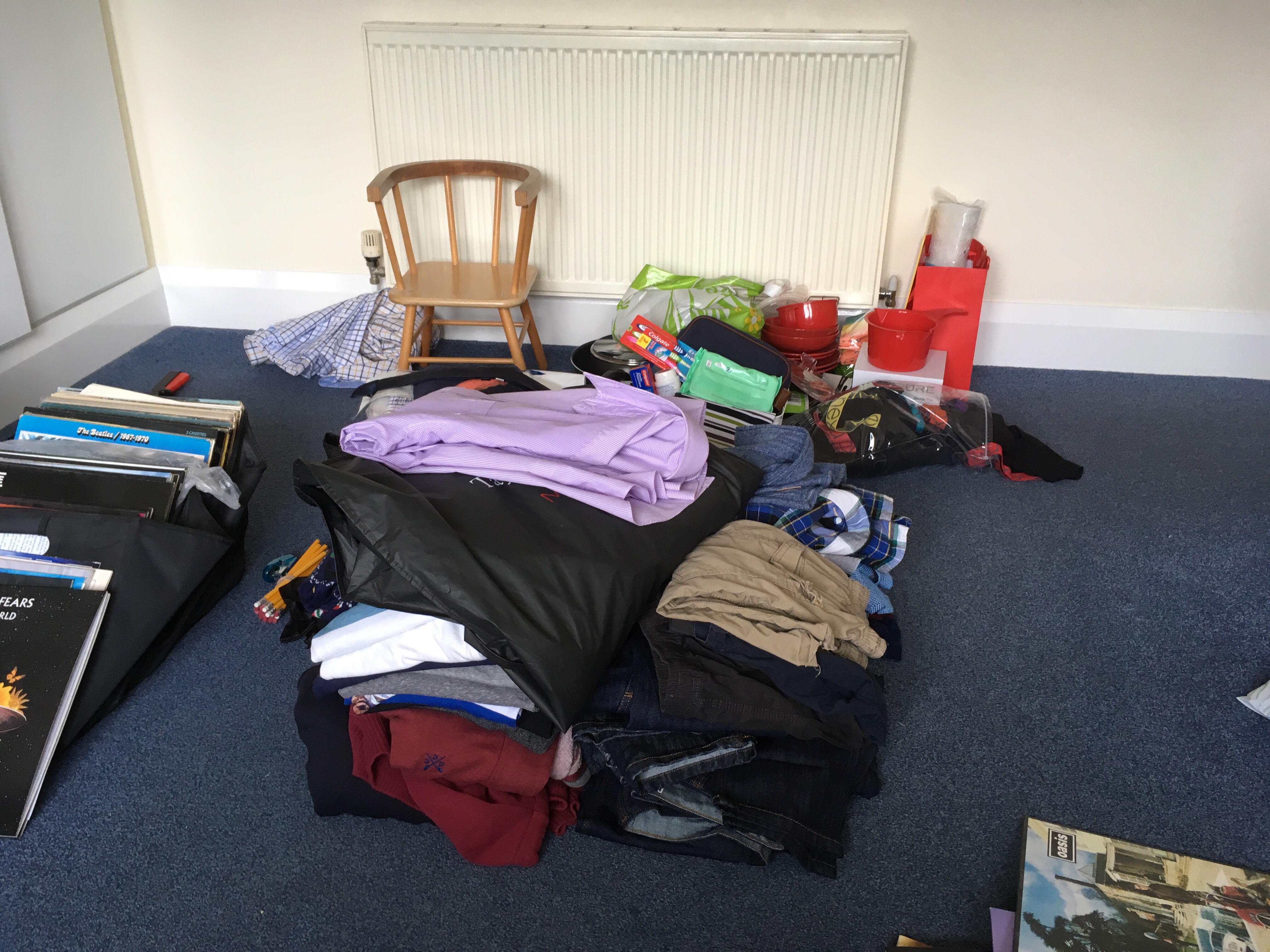 Allow me to present what is effectively Winchester Mission Control, just six days before we launch the rocket towards its destination. The large pile cluttering up the centre of the image above is made entirely of clothes I will be taking – in the process of clearing out the wardrobe, I was surprised to discover that I owned many more T-shirts than I thought I did! The garments that had to be retired after years of loyal service were consigned to one of two other piles, and as I write this they are destined either for the charity shop or to be used as miscellaneous rags in one of Dad’s many household jobs. I have to say that seeing everything I would definitely need grouped together made the whole exercise feel somewhat therapeutic – together with Mum I had been ruthless and made some sacrifices, which did feel quite calming. The first thing that introduced even a modicum of stress to proceedings was deciding what to wear to the ball I have booked a ticket for during my Freshers’ Week.
 Third Time Enabled